How to Protect a Boat Hull in Saltwater: A Complete Guide
- Why Is Saltwater So Hard on Boat Hulls?
- 1. Start With the Right Protection for the Underwater Hull
- 2. Control Galvanic Corrosion With Sacrificial Anodes
- 3. Wash the Hull Regularly After Saltwater Use
- 4. Protect the Hull Sides From UV, Scratches and Salt
- 5. What Is Yacht Armor™ and How Does It Protect a Boat?
- 6. Can Ceramic Coating Protect a Boat Hull in Saltwater?
- 7. What About Glidecoat for the Bottom of the Boat?
- 8. Yacht Armor vs. Glidecoat: Which Protection Does Your Boat Need?
- 9. Surface Preparation Is Just as Important as the Product
- 10. How Often Should You Protect a Saltwater Boat?
- 11. What Is the Best Way to Protect a Yacht in Fort Lauderdale?
- FAQ: Protecting a Boat Hull in Saltwater
- Key Takeaways
To protect a boat hull in saltwater, you need a combination of regular washing, appropriate antifouling or underwater protection, corrosion control, and a protective system for exposed surfaces. The right solution depends on whether you are protecting the submerged bottom, the hull sides and topsides, or both.
For long-term exterior protection, marine ceramic coatings such as Glidecoat can help create a smooth, hydrophobic surface, while Yacht Armor™ Marine Protection Film provides a physical barrier against scratches, abrasion, UV exposure and everyday marine wear on appropriate surfaces. Underwater hull protection is a separate consideration and should use a system specifically designed for continuous immersion.
Saltwater is one of the toughest environments for a boat. Every time your vessel leaves the dock, its surfaces are exposed to salt, moisture, UV radiation, marine organisms and physical abrasion. Over time, those conditions can lead to oxidation, staining, corrosion, marine growth and damage to the finish.
If you are asking how to protect a boat hull in saltwater, the answer is not simply “apply a coating.” Different areas of a boat face different problems, and the protection system needs to match the surface.
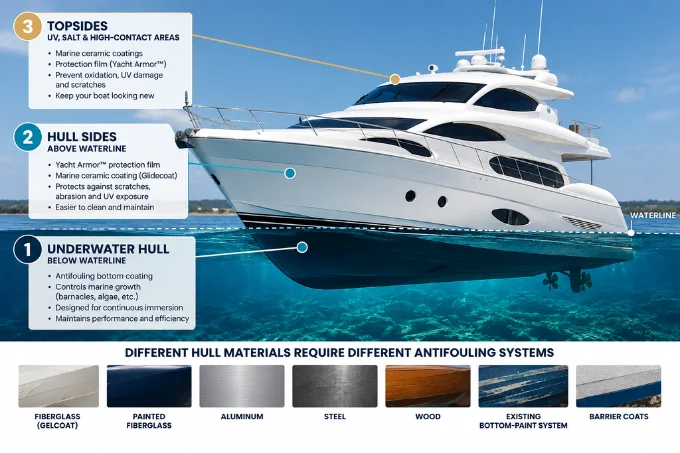
The underwater hull needs protection against marine growth and, depending on the hull material, corrosion. The exposed hull sides and topsides face UV, salt deposits, dock rash, scratches and oxidation. A professional maintenance strategy addresses each of these risks rather than relying on one product for everything.
If your yacht operates regularly in South Florida, a professional assessment can help determine which combination makes sense for your vessel.
Ready to protect your yacht? [Request a Free Consultation] to have your hull and exterior surfaces evaluated and receive a protection recommendation based on your vessel and operating conditions.
Why Is Saltwater So Hard on Boat Hulls?
Saltwater accelerates several types of marine surface damage, including corrosion, fouling, oxidation and contamination. The risk is especially significant for vessels that remain in the water continuously because the hull and underwater hardware have prolonged exposure to seawater.
Saltwater also acts as an electrolyte, allowing electrochemical reactions to occur between dissimilar metals. This is why corrosion protection for underwater hardware cannot be treated as simply a cosmetic issue.
What are the main threats to a boat hull in saltwater?
The most common threats include:
- Marine growth: Barnacles, algae and other organisms can attach to submerged surfaces.
- Galvanic corrosion: Dissimilar metals can react when electrically connected while submerged in saltwater.
- UV exposure: Sunlight can accelerate fading, oxidation and degradation of exposed finishes.
- Salt deposits: Dried salt and contaminants can leave deposits and contribute to surface deterioration.
- Physical abrasion: Docking, fenders, lines and everyday use can create scratches and scuffs.
- Oxidation: Gelcoat and painted surfaces can lose gloss and develop chalking or discoloration.
The important point is that these problems require different forms of protection.
Antifouling coatings are designed to control marine organisms on submerged surfaces. Sacrificial anodes address galvanic corrosion of appropriate underwater metal components. Surface coatings and protective films address different risks on exposed surfaces.
The U.S. Environmental Protection Agency defines antifouling coatings as coatings applied to boat hulls, bottoms and underwater structures to control marine fouling organisms.
The U.S. Environmental Protection Agency defines antifouling coatings as coatings applied to boat hulls, bottoms and underwater structures to control marine fouling organisms.
1. Start With the Right Protection for the Underwater Hull
If your boat stays in saltwater, the underwater portion of the hull requires a system designed for continuous immersion. For many vessels, this means an appropriate antifouling bottom coating selected according to the hull material, operating conditions and existing coating system.
Antifouling paint works differently from a cosmetic ceramic coating. Its primary purpose is to control marine growth such as barnacles and algae rather than simply make the surface glossy.
West Marine’s 2026 technical guidance notes that boats kept in the water require appropriate antifouling protection to help control marine growth and maintain performance.
What is antifouling paint?
Antifouling paint is a marine coating formulated to prevent or reduce the attachment and growth of organisms on submerged surfaces. Depending on the product, it may use biocides or other mechanisms to make the hull less hospitable to marine growth.
The correct product depends on the boat.
For example, aluminum hulls require particular care because certain copper-based antifouling products can create galvanic corrosion when used incorrectly. West Marine’s technical guidance specifically warns against using cuprous-oxide antifouling products on aluminum hulls unless the product is explicitly appropriate for that application.
Don’t treat every hull material the same
Before selecting an underwater coating, identify:
- Fiberglass or gelcoat
- Painted fiberglass
- Aluminum
- Steel
- Wood
- Existing bottom-paint system
- Previous barrier coats
The existing coating also matters. Applying an incompatible product over an old bottom-paint system can result in adhesion problems, premature failure or the need for extensive removal.
2. Control Galvanic Corrosion With Sacrificial Anodes
Protecting a boat hull in saltwater also means protecting the underwater metals connected to it. Sacrificial anodes are a critical part of this system because they are designed to corrode preferentially and help protect more valuable metal components.
Galvanic corrosion occurs when dissimilar metals are electrically connected and submerged in an electrolyte such as saltwater. The resulting electrochemical reaction can damage components such as propellers, shafts, trim tabs, rudders and other underwater hardware.
What do sacrificial anodes do?
Sacrificial anodes are made from relatively active metals such as zinc or aluminum. They are installed on appropriate underwater components so that the anode is consumed preferentially rather than the protected component.
For saltwater applications, zinc and aluminum anodes are commonly used, depending on the vessel and system requirements. Magnesium is generally associated with freshwater applications.
One common mistake: painting over anodes
Anodes need electrical contact with the surrounding water to perform their intended function. Covering them with paint or another insulating coating can prevent them from working correctly.
For this reason, anodes should be inspected whenever the boat undergoes underwater maintenance or coating work.
A professional inspection should also consider:
- Anode condition
- Electrical bonding
- Underwater metals
- Stray-current risks
- Damage to the coating system
- Exposed bare metal
This is particularly important for yachts with complex underwater systems.
3. Wash the Hull Regularly After Saltwater Use
One of the simplest ways to protect a boat hull in saltwater is also one of the easiest to overlook: rinse the vessel regularly.
Salt deposits and contaminants should not be allowed to remain on exterior surfaces longer than necessary. Regular washing helps remove salt, dirt and environmental contaminants before they accumulate.
For boats operating in South Florida, this becomes especially important because the vessel may be exposed to saltwater, intense sunlight and humidity throughout the year.
How often should you wash a saltwater boat?
There is no single interval that works for every vessel. Frequency should depend on:
- How often the boat is used
- Whether it is kept in a slip
- Whether it is stored on a lift
- Local environmental conditions
- Amount of salt exposure
- Surface protection already installed
The goal is consistency rather than waiting until the hull visibly looks dirty.
A protected surface can make routine washing easier because hydrophobic coatings and films can reduce the amount of contamination that adheres strongly to the surface.
4. Protect the Hull Sides From UV, Scratches and Salt
The hull sides above the waterline experience a different type of abuse than the underwater bottom.
Here, the primary concerns are often UV exposure, oxidation, staining, scratches, dock contact and abrasion.
This is where marine surface-protection systems such as ceramic coatings and marine protection film can become particularly useful.
Florida Marine Coatings describes Yacht Armor™ as a marine protection film designed to provide a physical barrier against scratches, UV exposure and everyday surface wear. The company installs Yacht Armor™ on hull sides and other exposed areas in South Florida.
5. What Is Yacht Armor™ and How Does It Protect a Boat?
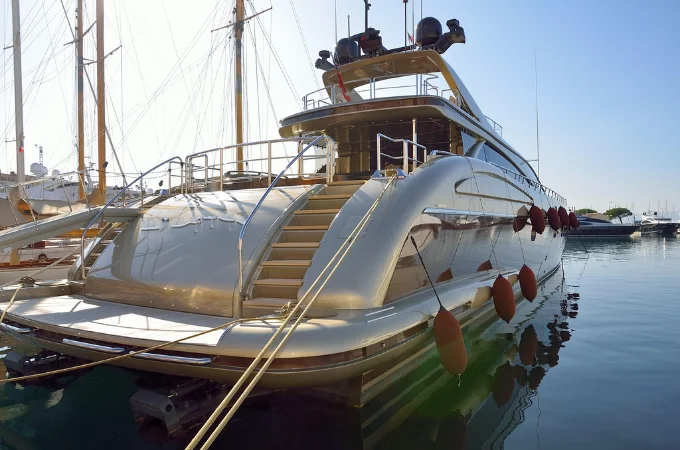
Yacht Armor™ Marine Protection Film is a transparent protective film designed to physically shield appropriate marine surfaces from abrasion, scratches, UV exposure and everyday wear. Unlike a liquid ceramic coating, the film creates a physical layer between the environment and the underlying surface.
This distinction matters.
A ceramic coating primarily modifies the surface characteristics of the substrate. A protection film adds physical material over the substrate, providing another layer between the boat and potential damage.
Florida Marine Coatings identifies Yacht Armor™ as a self-healing marine protection film and offers certified installation in Fort Lauderdale and surrounding South Florida markets.
Where can Yacht Armor™ be useful?
Depending on the application and manufacturer’s specifications, marine protection film can be considered for high-exposure surfaces such as:
- Hull sides
- Transoms
- Engine cowls
- Painted surfaces
- Cockpit counters
- Tables
- High-contact areas
- Other vulnerable exterior surfaces
The biggest advantage is that the film provides physical protection, rather than relying exclusively on the hardness or chemistry of a surface coating.
Why installation quality matters
Marine protection film is only as good as the preparation and installation behind it.
The surface needs to be properly cleaned, corrected and prepared before application. Contamination, oxidation or surface imperfections can affect the final appearance and performance.
For a high-value yacht, professional installation is therefore more than an aesthetic consideration. It is part of the protection system.
6. Can Ceramic Coating Protect a Boat Hull in Saltwater?
Yes, a marine ceramic coating can provide useful protection on appropriate boat surfaces, particularly against UV exposure, oxidation, staining and water-related contamination. However, ceramic coating should not automatically be treated as a substitute for every type of underwater hull protection.
Glidecoat’s Marine Ceramic Coating is specifically designed for marine surfaces including gelcoat, painted surfaces, stainless steel, vinyl wraps and other boat components. Its application instructions emphasize thorough cleaning, compounding and polishing where necessary before application.
What does a marine ceramic coating do?
A properly applied ceramic coating can create a smooth, hydrophobic surface that:
- Repels water more effectively
- Reduces contamination adhesion
- Makes washing easier
- Helps protect against UV exposure
- Enhances gloss
- Helps preserve a properly prepared finish
The preparation step is critical.
Glidecoat specifically states that oxidation, water stains, surface imperfections, wax and silicone contamination should be addressed before application. The manufacturer also notes that coating can effectively lock existing imperfections into the finished appearance.
That is why professional surface correction before coating is so important.

7. What About Glidecoat for the Bottom of the Boat?
Not every ceramic coating is intended for continuous immersion. Glidecoat offers specific products designed for underwater applications, including MAX Ceramic Coating, which the manufacturer describes as a coating intended for use below the waterline and as an alternative to traditional bottom paint.
Glidecoat also offers an Underwater Anti-Microbial Ceramic Coating designed specifically for submerged hull surfaces. The manufacturer states that it is intended to deter marine growth and can be used as an alternative to bottom paint on appropriate substrates.
This illustrates an important rule:
Never assume that a generic ceramic coating is suitable for continuous underwater immersion.
The product must be specifically designed and approved for the intended marine application.
8. Yacht Armor vs. Glidecoat: Which Protection Does Your Boat Need?
Yacht Armor and Glidecoat solve related but different problems.
Yacht Armor™ is a physical protection film, while Glidecoat is a ceramic coating system. The choice depends on the surface, the type of damage you are trying to prevent, maintenance expectations and how the boat is used.
| Protection | Yacht Armor™ | Glidecoat Marine Ceramic |
| Physical film barrier | Yes | No |
| Scratch/abrasion protection | Strong focus | Limited compared with film |
| Hydrophobic behavior | Yes | Yes |
| Gloss enhancement | Yes | Strong focus |
| UV protection | Yes | Yes |
| Self-healing film | Yes | No |
| Underwater-specific options | Application-dependent | Specific products available |
| Best use case | High-contact/high-wear surfaces | Surface protection and easier maintenance |
Florida Marine Coatings recommends these technologies for different protection objectives and also offers combinations of film and ceramic protection for different areas of a vessel.
The best approach may be a combination
A yacht does not necessarily need to use one technology everywhere.
For example, a protection strategy could involve:
Underwater hull:
Appropriate antifouling or an underwater-specific coating.
Hull sides:
Yacht Armor™ where abrasion and physical contact are major concerns.
Topsides:
Marine ceramic coating where gloss, UV protection and easier maintenance are priorities.
Underwater metal:
Properly maintained sacrificial anodes and compatible protective systems.
This zone-based approach is often more logical than applying one product indiscriminately across the entire vessel.
Your boat’s size, hull material, storage conditions and existing coatings all affect the right protection strategy.
Want to know which combination makes sense for your vessel? Request a Free Consultation with Florida Marine Coatings for a professional evaluation and a customized marine surface-protection plan.
9. Surface Preparation Is Just as Important as the Product
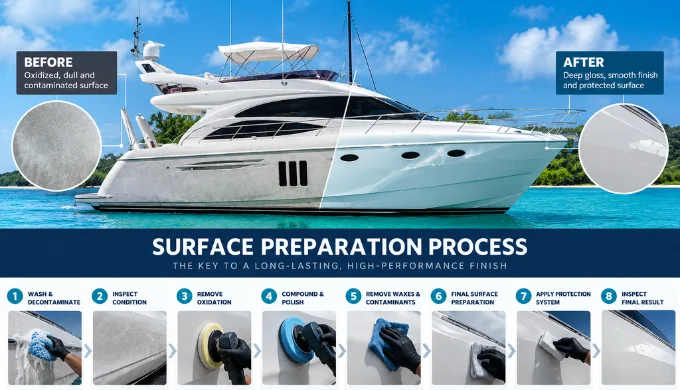
One of the biggest mistakes in marine coating projects is focusing on the product while overlooking preparation.
A coating or film cannot correct a badly oxidized, contaminated or poorly prepared surface. In fact, applying a protective layer over defects can make those defects more difficult to correct later.
Glidecoat’s application instructions specifically call for washing, compounding and polishing as needed before ceramic coating. The manufacturer also requires removal of waxes, silicones and other contaminants that could interfere with bonding.
A professional preparation process may include:
- Wash and decontaminate the surface
- Inspect gelcoat or paint condition
- Remove oxidation
- Compound and polish where necessary
- Remove waxes and silicone contamination
- Perform final surface preparation
- Apply the selected protection system
- Inspect the finished surface
This process is especially important on high-end yachts where the final finish needs to be both functional and visually consistent.
10. How Often Should You Protect a Saltwater Boat?
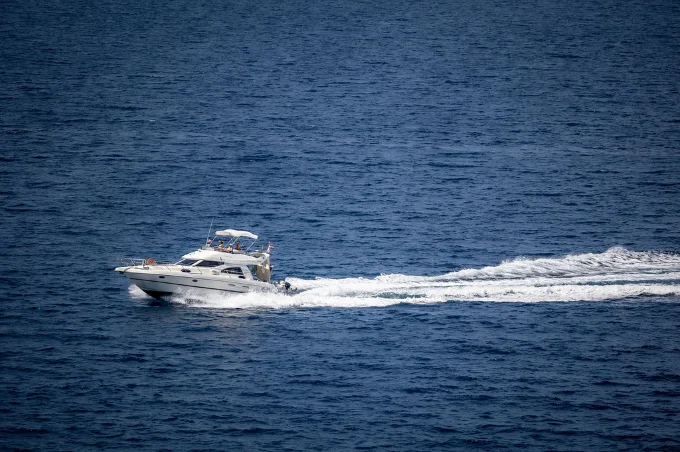
The correct maintenance interval depends on the boat, its environment and the protection system installed. A yacht kept in a marina year-round generally needs a more proactive maintenance program than a trailerable boat that spends most of its time out of the water.
Florida Marine Coatings recommends routine detailing based on vessel usage and conditions and offers ceramic coating and Yacht Armor™ solutions for South Florida vessels.
A practical maintenance program should include:
After regular saltwater use
- Rinse exterior surfaces
- Remove visible salt deposits
- Inspect high-contact areas
- Check for scratches or chips
During regular detailing
- Deep-clean surfaces
- Inspect oxidation
- Check protective coatings
- Inspect film edges and vulnerable areas
- Restore gloss where required
During haul-out
- Inspect the underwater hull
- Evaluate antifouling condition
- Inspect anodes
- Check underwater metals
- Look for blistering, damage or coating failure
- Repair exposed areas before relaunch
The objective is to identify small problems before they become expensive repairs.
11. What Is the Best Way to Protect a Yacht in Fort Lauderdale?
For yachts operating in Fort Lauderdale, protection should account for year-round sun exposure, saltwater, humidity, marina conditions and frequent use.
There is no single “best” product for every surface. A better strategy is to match the protection technology to the exposure.
Florida Marine Coatings provides certified Yacht Armor™ installation and marine ceramic coating services in Fort Lauderdale and surrounding South Florida areas. Its published service approach combines surface preparation with protection systems selected according to the vessel and intended use.
For a yacht that spends most of its time in the water, a professional evaluation should consider the complete vessel rather than just the visible hull.
That includes:
- Underwater hull
- Waterline
- Hull sides
- Transom
- Topsides
- Engine cowls
- Stainless hardware
- Glass
- High-contact surfaces
- Existing protective coatings
FAQ: Protecting a Boat Hull in Saltwater
1. How do I protect my boat hull from saltwater?
Protect your boat hull with regular salt removal, an appropriate underwater antifouling or coating system, corrosion protection for underwater metals, and surface protection for exposed hull areas. The correct combination depends on hull material, storage conditions and how frequently the vessel remains in saltwater.
2. Does saltwater damage boat gelcoat?
Saltwater exposure can contribute to staining, deposits and surface deterioration, particularly when combined with UV exposure and inadequate maintenance. Regular washing, surface correction and an appropriate marine coating or protection film can help preserve the finish.
3. Is Yacht Armor™ good for boat hull protection?
Yacht Armor™ is designed as a physical marine protection film for appropriate surfaces exposed to scratches, abrasion, UV and everyday wear. It can be particularly useful on hull sides and other high-contact areas, but it should not automatically be considered a replacement for a dedicated underwater antifouling system.
4. Is Glidecoat good for saltwater boats?
Glidecoat offers marine ceramic coatings designed for boat surfaces and also offers products specifically intended for underwater applications. The correct Glidecoat product depends on whether the surface is above or below the waterline and the conditions in which the vessel operates.
5. Can ceramic coating replace bottom paint?
Some specialized underwater ceramic coatings are designed as alternatives to traditional bottom paint, but a standard topside ceramic coating should not automatically be used below the waterline. Always verify that the specific product is designed and approved for continuous immersion and the intended substrate.
6. How often should I wash my saltwater boat?
The appropriate washing frequency depends on usage, storage and environmental exposure. Boats kept in saltwater year-round generally benefit from more frequent salt removal than vessels that are routinely hauled or stored out of the water.
7. How do I prevent galvanic corrosion on a saltwater boat?
Galvanic corrosion can be managed through appropriate sacrificial anodes, proper electrical bonding, compatible materials and regular inspection of underwater metal components. Anodes must remain functional and should not be covered with insulating coatings.
8. Can Yacht Armor and ceramic coating be used together?
They can be used strategically on different surfaces when the products and substrates are compatible. For example, a yacht may use protection film on high-contact hull areas and ceramic coating on other exterior surfaces where gloss, hydrophobic behavior and easier maintenance are priorities.
9. Does a new boat need hull protection?
A new boat can benefit from early protection because preventing contamination, oxidation and physical damage is generally easier than restoring a deteriorated surface. The appropriate protection should be selected based on the boat’s materials, operating environment and manufacturer’s recommendations.
Key Takeaways
- Protecting a boat hull in saltwater requires multiple layers of protection, because underwater fouling, galvanic corrosion, UV exposure and physical abrasion are different problems.
- Antifouling systems are designed to control marine growth on submerged surfaces, while other coatings address different types of surface exposure.
- Sacrificial anodes are an important part of underwater corrosion protection for appropriate metal components exposed to saltwater.
- Yacht Armor™ provides a physical protection film that can help shield appropriate hull and exterior surfaces from scratches, abrasion and environmental exposure.
- Glidecoat offers marine ceramic coatings for surface protection, hydrophobic performance and easier maintenance, as well as specific products intended for underwater applications.
- Surface preparation is critical because coatings and films cannot compensate for oxidation, contamination or poor adhesion preparation.
- A zone-based protection strategy can be more effective than using one product everywhere, with different technologies selected for the underwater hull, hull sides and topsides.
Your yacht deserves a protection system designed around how it is actually used—not a one-size-fits-all coating.
Request a Free Consultation with Florida Marine Coatings to evaluate your vessel, identify its highest-risk surfaces and determine whether Yacht Armor™, Glidecoat, underwater protection or a combination of systems is appropriate for your yacht.
Knowing how to protect a boat hull in saltwater starts with understanding that no single product solves every marine exposure. The underwater hull needs protection against fouling and, where applicable, corrosion. Exposed surfaces need defense against UV, salt deposits, oxidation, scratches and everyday wear.
The most effective strategy is therefore based on the vessel’s material, operating environment, storage conditions and maintenance goals. Products such as Yacht Armor™ and Glidecoat can play an important role when selected for the correct surface and applied over properly prepared substrates.
If your yacht operates in Fort Lauderdale or throughout South Florida, a professional assessment can help you determine where protection will deliver the greatest long-term value.
Request a Free Consultation with Florida Marine Coatings and develop a customized protection plan for your vessel.